From unlocking your phone with your face to recommending your next favorite movie, neural networks are quietly powering many of the technologies you use every day. But what is a neural network, and how do machines actually learn from data? In this guide, we’ll break down neural networks in the simplest way possible, using real-life examples, analogies, and beginner-friendly code.
You wake up in the morning. You pick up your phone, and it unlocks instantly—just by looking at your face. No password. No fingerprint. Just you.
Later, you open Netflix. And somehow… it already knows what you want to watch.
Then you check your email. Spam messages are already filtered out.
Ever wondered… How do these systems know so much about you?
Behind all these smart features, there is something powerful working silently. A system that learns from data, improves over time, and makes decisions just like a human brain. That system is called a Neural Network.
What is a Neural Network?
A neural network is a machine learning model that learns patterns from data and makes predictions, similar to how the human brain works. Instead of following fixed rules, neural networks:
- Learn from examples
- Identify patterns
- Improve over time
A neural network is a system that learns from experience.
Neural Networks Explained with a Simple Example
Imagine teaching a child to recognize a dog. You will do that in multiple steps
- First Step: Show many dog images
- Second Step: Tell them “This is a dog”
- Third Step: After some time the child will automatically recognize dogs.
Since we have shown the dog image multiple times so child brain neurons undersftands the pattern (here shape and characteristic) of the animal.
Neural networks learn in the same way:
- Input → data
- Learning → pattern recognition
- Output → prediction
Another example of Neural network understanding
Let’s say you want to teach a child to identify a cat. You show the child
- 1000 images of cats
- 1000 images of non-cats
After learning from the images and forming a pattern the child can says that
- Yes, this is a cat
- No, this is not a cat
That learning system = Neural Network
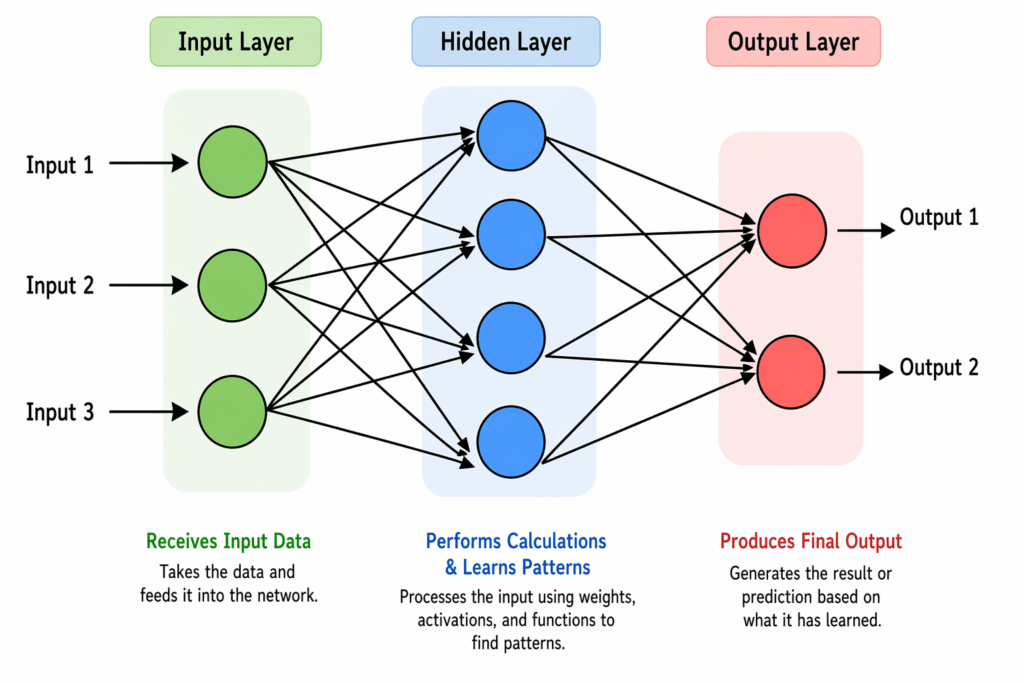
Three Layers of a Neural Network
You can divide the work of a Neural network in three important layers.
Input Layer: This is where data enters the systems. The data can be either text, number or images etc
Hidden Layer: This is where learning happens. It extracts patterns, perform calculations, Improve accurancy
Output Layer: This layer produces the final result. The result can be as simple Yes/ No or category based response, prediction.
Inside a neural network the below process is repeated multiple times
- Data goes in
- It gets multiplied & adjusted
- The system makes a guess
- If wrong → it corrects itself
- Repeat thousands of times
This process is called learning. Neural Networks are very powerful because they can learn automatically, improve over time and handle complex problems. Unlike traditional programming, You don’t tell them rules. You give them data, and they learn rules themselves
Real Life example of Neural Network
As todays life is tech savvy and we depend on may app to do our daily activities. There are chances that you would have been using a Neural Network but still you don’t know about it
- Face unlock on your phone
- Netflix recommendations
- Amazon product suggestions
- Voice assistants (Siri, Alexa)
- Self-driving cars
Neural Network vs Human Brain Comparison
This is a simple comparison between a human brain and a Neural network
| Humain Brain | Neural Network |
|---|---|
| Learns from experience | Learns from data |
| Neurons | Learns from data |
| Makes decisions | Artificial neurons |
| Makes decisions | Predicts outcomes |
Neural networks ar powerful but it needs lots of data and it can make mistakes which are sometime hard to understand.
Create your first Neural Network – Predict if a student will pass or fail
Let’s build a tiny neural network that learns the number of hours a students reads and then predicts pass and fail. we will be using the google tensorflow library to create our first neural network.
Tensorflow is the most powerful python library to create Neural Network
Step 1: Install the libary
pip install tensorflowStep 2: The code
import tensorflow as tf
from tensorflow import keras
import numpy as np

# Input data (hours studied)
X = np.array([1, 2, 3, 4, 5], dtype=float)

# Output data (0 = fail, 1 = pass)
y = np.array([0, 0, 0, 1, 1], dtype=float)

# Create a simple neural network
model = keras.Sequential([
    keras.layers.Dense(units=1, input_shape=[1])
])

# Compile the model
model.compile(optimizer='sgd', loss='mean_squared_error')

# Train the model
model.fit(X, y, epochs=500, verbose=0)

# Predict
print(model.predict([6.0]))- If a students fails then it is denoted by 0 and if a student pass then it is denoted by 1
- we give number of hours studied by the student and then give the output of fail and pass also
- X denotes the number of hours studied
- y denotes whether the student failed or passed
- From the data we can clearly infer that if the students studies more than or equal to 4 hours then it is pass.
- The neural network
- Learns the pattern
- Understands relationship
- Predicts new data
- When you input
6 hours, it predicts high chances of passing
Even though this example is simple, the same concept powers complex systems like recommendation engines, fraud detection, and self-driving cars.
- When building neural networks, we use some powerful tools (libraries) in Python.
- TensorFlow
- Keras
- NumPy
- NumPy is a library used to work with numbers and data efficiently.
- Store data (like lists, arrays)
- Perform fast calculations
- Handle large datasets
- TensorFlow is a powerful library developed by Google. It is used to
- Build neural networks
- Train models
- Make predictions
- Keras is a high-level API (simpler interface) that runs on top of TensorFlow. It makes it easy to
- Build Models
- Add Layers
- Train Neural Network
Putting It All Together
| Tool | Role | Analogy |
|---|---|---|
| NumPy | Handles data | Ingredients |
| TensorFlow | Does heavy computation | Engine |
| Keras | Makes it easy to use | Control panel |
Important Code Understanding
model = keras.Sequential([
    keras.layers.Dense(units=1, input_shape=[1])
])- This line creates the neural network model.
- keras.Sequential(…)
- This means we are creating the model layer by layer in sequence.
- keras.layers.Dense(…)
- This creates a dense layer, which means every input is connected to the neuron.
- units=1 : This means this layer has 1 neuron.
- Since our output is simple — pass or fail — we only need one output neuron.
- This creates a dense layer, which means every input is connected to the neuron.
input_shape=[1]–- This means each input has 1 value. For example: 1 hour, 2 hours, 3 hours
- Each student gives just one input number, so input shape is 1.
model.compile(optimizer='sgd', loss='mean_squared_error')- This line prepares the model for learning. It tells the neural network:
- how to improve itself
- how to measure mistakes
optimizer='sgd'sgdmeans Stochastic Gradient Descent. This is the method the model uses to improve step by step. In simple words, It helps the model adjust itself after making mistakes.
loss='mean_squared_error'- This tells the model how to calculate the error. It checks on how far the prediction is from the correct answer
- Smaller loss means better predictions
model.fit(X, y, epochs=500, verbose=0)- This is for training the model
Xis the input data- y is the correct answers
epochs=500- This means the model will practice learning 500 times.
- The more it practices, the better it can learn the pattern.
verbose=0- This hides the training logs from the screen.
- Without this, TensorFlow would print lots of training messages.
print(model.predict([6.0]))- After training the model now is the turn to do the predictions
- We are asking:
- If a student studies for 6 hours, what does the model predict?
- Since the model learned that low hours usually mean fail and higher hours usually mean pass
it will likely predict a value close to 1, which means pass.
Create your second Neural Network : Predict House Price
Let’s build a neural network that predicts the price of a house based on the size of the house (square feet). we are going to feed the neural network that
- smaller the size lower is the price
- higher the size higher is the price
import tensorflow as tf
from tensorflow import keras
import numpy as np
# Input: house size (in 1000 sq ft)
X = np.array([1, 2, 3, 4, 5], dtype=float)
# Output: price (in lakhs)
y = np.array([50, 100, 150, 200, 250], dtype=float)
# Create model
model = keras.Sequential([
    keras.layers.Dense(units=1, input_shape=[1])
])
# Compile model
model.compile(optimizer='sgd', loss='mean_squared_error')
# Train model
model.fit(X, y, epochs=500, verbose=0)
# Predict price for 6 (6000 sq ft)
print(model.predict([6.0]))The code explanation is similar to the first one.
Frequently Asked Questions (FAQs)
Q1: What is a neural network in simple words?
A neural network is a system that learns from data and makes predictions, similar to how humans learn.
Q2: Where are neural networks used?
They are used in face recognition, recommendations, spam detection, and AI systems.
Q3: Is neural network hard to learn?
No, beginners can understand it easily with simple examples.
Q4: What is the difference between AI and neural networks?
AI is a broad field, while neural networks are a technique within AI.
Conclusion
Neural networks are at the core of modern artificial intelligence. They learn from data, identify patterns, and make intelligent decisions just like humans, but at scale. If you understand the basics of neural networks, you’ve already taken your first step into AI.
 Raj Ranjan